

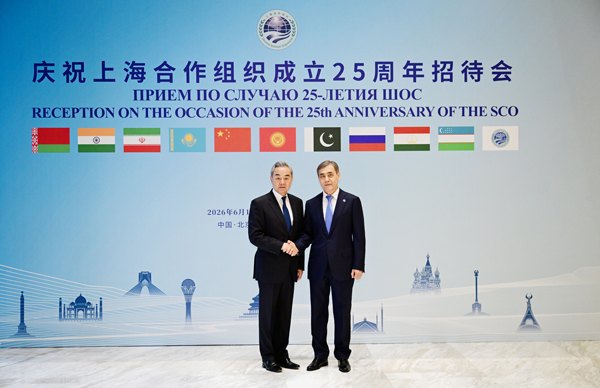
On June 15, 2026, Wang Yi, Member of the Political Bureau of the CPC Central Committee and Minister of Foreign Affairs, attended and addressed a reception in Beijing celebrating the 25th anniversary of the founding of the Shanghai Cooperation Organization.
Wang Yi stated that the establishment of the SCO 25 years ago opened a new chapter in contemporary international relations. Over the past quarter-century, member states have demonstrated solidarity and cooperation, shouldered moral responsibilities, pursued development together, and learned from one another, thereby fostering the "Shanghai Spirit" of mutual trust, mutual benefit, equality, consultation, respect for diverse civilizations, and pursuit of common development. They have also pioneered a new model of regional cooperation characterized by partnership rather than alliance among neighboring countries, joint commitment to security and stability, and shared promotion of development and prosperity, while establishing a new type of international relations centered on mutual respect, equity, justice, and win-win cooperation.
Wang Yi noted that profound changes unseen in a century are accelerating, leading to increased turbulence and uncertainty in the international landscape. President Xi Jinping, with his vision for the world, has put forward four major global initiatives and advocated for building a community with a shared future for mankind, thus charting the course of our times and offering a Chinese solution. As a crucial force for stability, constructiveness, and progress in today's world, the SCO should play an even greater role, taking responsibility and setting an example in promoting world peace, development, cooperation, and mutual benefit.
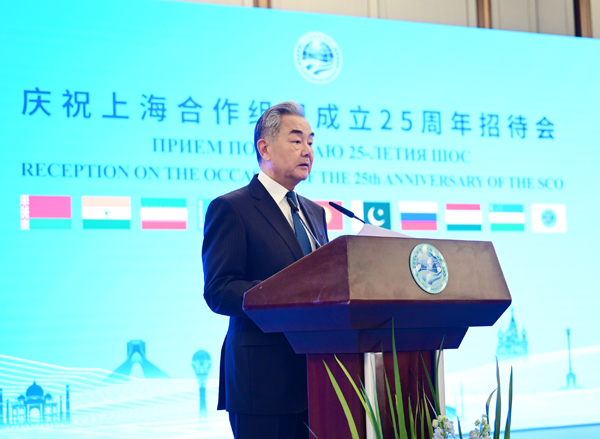
Wang Yi emphasized the need to carry forward the "Shanghai Spirit," ensuring that the SCO's cooperation deepens further, its path broadens, its relations become smoother, and its cohesion, capacity for action, and appeal continue to strengthen.
He called for improving global governance by practicing true multilateralism, upholding the principles of extensive consultation, joint contribution, and shared benefits, safeguarding the authority and role of the United Nations, and promoting a fairer, more orderly multipolar world and an inclusive, universally beneficial economic globalization.
It is essential to uphold peace and tranquility by adhering to a vision of common, comprehensive, cooperative, and sustainable security; advancing peace and stability in the Middle East; supporting Afghanistan's reconstruction and development; and achieving lasting peace and stability in the region.
Sustainable development must be promoted by creating growth drivers in trade, investment, connectivity, technological innovation, green industries, and the digital economy; expediting the establishment of a development bank; strengthening industrial chains; stabilizing supply chains; and upgrading value chains.
Good-neighborly friendship and cooperation should be enhanced through people-to-people exchanges, dialogue among civilizations, support for grassroots friendship, and joint efforts to build five shared homes: peaceful, tranquil, prosperous, beautiful, and friendly.
Wang Yi expressed confidence that, under the strategic guidance of President Xi Jinping and the leaders of member states, the Tianjin Summit has outlined a blueprint for the SCO's development over the next decade. He believes this year's Bishkek Summit will further consolidate consensus among all parties and propel regional countries toward sustainable peace, development, and prosperity. As this year marks the beginning of China's 15th Five-Year Plan period, China stands ready to share development opportunities with all SCO member states, achieve win-win cooperation, and usher in an even brighter and better future for the region.
In his address, SCO Secretary-General Ermekbayev stated that after 25 years of hard work, the SCO has entered maturity and become the largest transregional international organization. At the September 2025 Tianjin Summit, the SCO adopted its Development Strategy for the Next Decade, setting ambitious yet realistic goals aimed at enhancing the effectiveness of cooperation. Currently, international attention toward the SCO continues to rise, demonstrating the broad appeal of its values and principles. He expressed hope that all member states will work together to continuously benefit their peoples and advance the cause of regional peace and development.
Approximately 200 guests attended the reception, including ambassadors and envoys of SCO member states accredited to China, as well as representatives of international organizations based in China.