

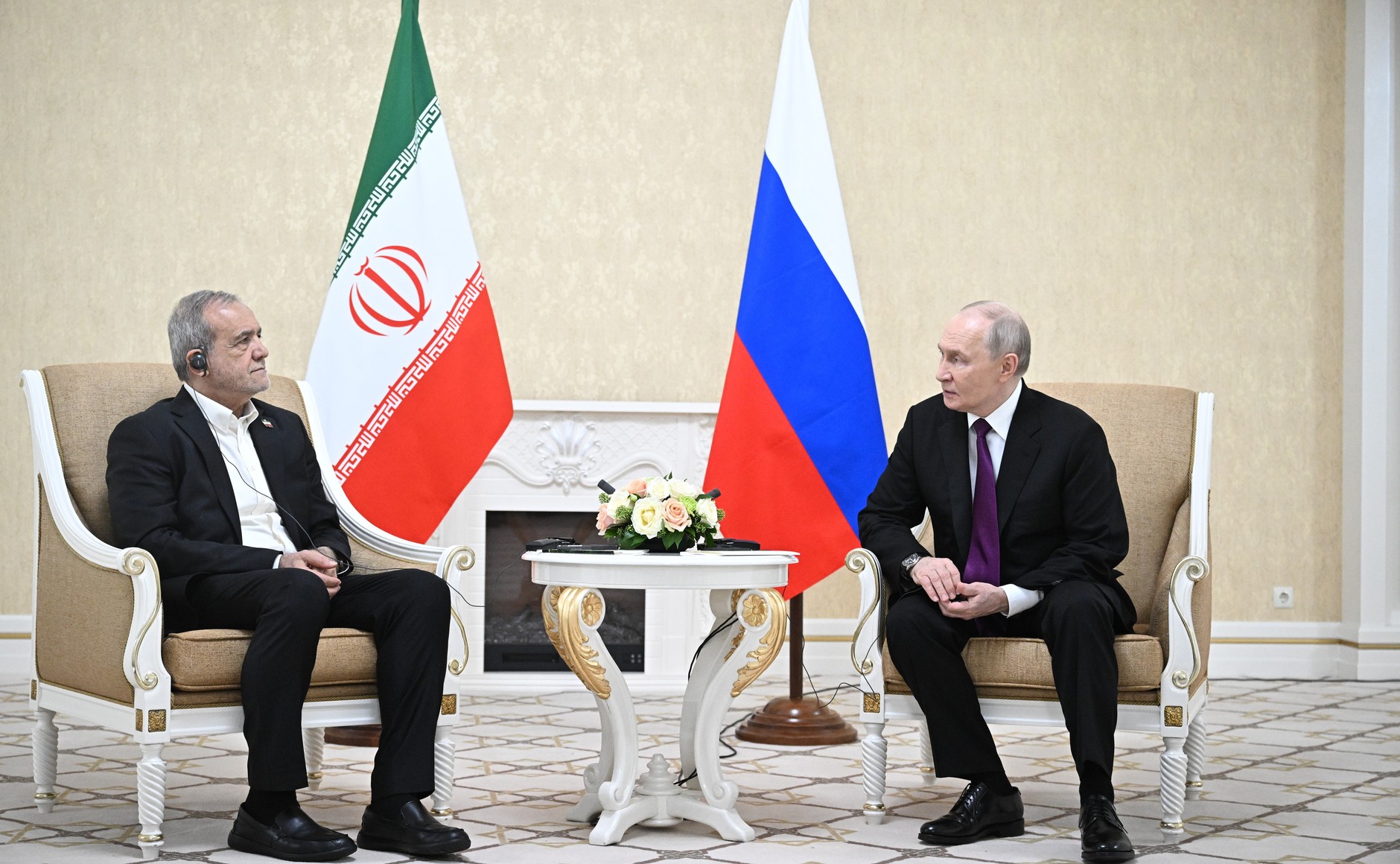
October 8, 2026: Russian President Vladimir Putin and President of the Islamic Republic of Iran Masoud Pezeshkian held bilateral talks in Turkmenbashi, exchanging views on current issues in Russia-Iran cooperation as well as the regional situation.
Opening the talks, Russian President Putin noted that the two leaders had recently met in Bishkek on the sidelines of the Shanghai Cooperation Organization summit. He said this meeting provides an opportunity to discuss the state of relations between the two countries, the regional situation, and developments in related matters.
Putin pointed out that Russia-Iran bilateral relations, grounded in a foundational treaty signed early last year, continue to develop positively. Economic cooperation has yielded encouraging results, with trade between the two countries increasing by more than 21% last year, a trend that has persisted through the first seven months of 2026. Exchanges in the cultural and humanitarian spheres have also been highly productive, with numerous joint events serving as exemplary models. Overall, ties between the two nations are steadily strengthening. Putin conveyed his best wishes to Iran’s Supreme Leader via President Masoud Pezeshkian, praying for the leader’s health and well-being.
Turning to current regional flashpoints, Putin stated that the regional situation represents one of today’s most pressing challenges. He observed that Iran is taking concrete steps to de-escalate regional conflicts—conflicts that Iran did not initiate—and has once again proposed new initiatives aimed at peacefully mediating the situation. Putin emphasized Russia’s readiness to assist, within its capabilities, in advancing such mediation efforts, adding that both sides could engage in in-depth consultations on all relevant issues.
President Masoud Pezeshkian of the Islamic Republic of Iran expressed gratitude for the renewed meeting and extended birthday greetings to Putin, wishing Russia prosperity and development. Pezeshkian noted that Russia and Iran currently cooperate across nearly all sectors, with steady progress in economic, trade, and cultural-humanitarian fields. Both countries possess strong political will to further deepen cooperation under their signed Strategic Partnership Treaty, believing that collaboration across various domains will help resolve existing challenges.
Pezeshkian then addressed the issue of unilateralism. He stated that the United States pursues unilateral policies, seeking to impose its own positions on other nations, while certain politicians attempt to export domestic political agendas to other countries. Pezeshkian commended Putin for repeatedly voicing public opposition to unilateralism, noting that Iran shares this perspective. He explained that during previous Iran-U.S. negotiations, the U.S. side frequently resorted to confrontational measures mid-process, yet Iran never withdrew from the talks. He added that Iran is currently reviewing negotiation progress, having exchanged proposals with the U.S. and revised U.S. drafts accordingly. Once the final text is finalized, Iran will continue to consolidate and coordinate various initiatives through intermediaries.
Pezeshkian thanked Russia for its stance on regional affairs and within the framework of the United Nations. He said that, thanks to Russian support, the U.S. has been unable to impose its unilateral agenda on Iran. He expressed Iran’s desire to bring the war to an end as soon as possible, stressing that all parties must respect Iran’s legitimate rights; however, if the U.S. persists in unilateral thinking, these goals will remain difficult to achieve in the short term. He affirmed that Iran will rely on mutual consensus and existing bilateral initiatives to do its utmost to implement relevant proposals. Pezeshkian believes that Russia-Iran relations rest on a solid foundation and favorable external conditions, allowing both sides to further accelerate the pace of bilateral cooperation.